The final SOAR (Spin Off Autumn Retreat) took place in St. Charles, IL last week; though I didn't get to take any classes, my pal Lauren and I did shop the vendor marketplace on Saturday. It was a small, well-curated affair that had temptation at every turn. I really wish I had remembered to pack one of the "good" cameras, because all I was able to take was a few instagrams; luckily Lauren had packed her camera and could fill in some of the gaps.
I love small shows like this - for one, they aren't nearly so overwhelming (and I get easily overwhelmed since most of my days are spent in my home office with only the cats and my husband for company). Another bonus is that they often have a mixture of small and medium-sized companies with a few larger ones to balance out the mix, while larger (read: more expensive) shows are usually comprised of the bigger companies with a few medium-sized ones scattered throughout. Not that there's anything wrong with that, but it's just my personal preference to dig the smaller, more intimate setting with more varied (and smaller) vendors.
I chatted with some truly interesting people and learned a lot - for instance, Lauren and I spent a lot of time in the Jefferson Farms Natural Fibers booth; they specialize in Paco-Vicunas, and the owner Jane was incredibly friendly. She told us all about the fiber, and I am hoping to visit the farm in Colorado some day soon because it sounds amazing. I only wish I'd had an endless budget to bring home more of the fibery goodness that caught my eye. Instead, I practiced restraint and only purchased 3 items:
 From L-R: Grey Gotland from Spinning Straw Into Gold, CVM/Alpaca/Silk/Bamboo from Fiber Curio and Sundries, and some natural black Huacaya Alpaca from Alpacas d'Auxvasse.
Another booth I spent a lot of time in was Fiber Curio and Sundries; Ellen explained that they source and process everything in the USA without the use of harsh chemicals, which is totally awesome. They had a lot of really unique fibers, and they could even tell me the name of the CVM sheep, Ella, whose fleece was used to make the top I purchased! How cool is that?!
Lauren purchased some really fun Polwarth-blend top from Lucky Cat Craft; they were another booth with a lot of unique fiber options, and though I didn't purchase anything at the show, I made a point to grab their card so I can check out their Etsy shop in the future!
I was so excited about my fiber purchases that I ended up spinning up a single of the black alpaca on Saturday night and Navajo plying it on Sunday:
 Next up is Vogue Knitting Live at the Palmer House Hilton in downtown Chicago! I will only be there on Sunday in a (probably) vain attempt to minimize the amount of stash enhancement this show is likely to have. Incidentally, if you still haven't purchased your marketplace tickets, you can enter HALFOFFCHI13 at checkout when you buy ahead of time online. See you there!
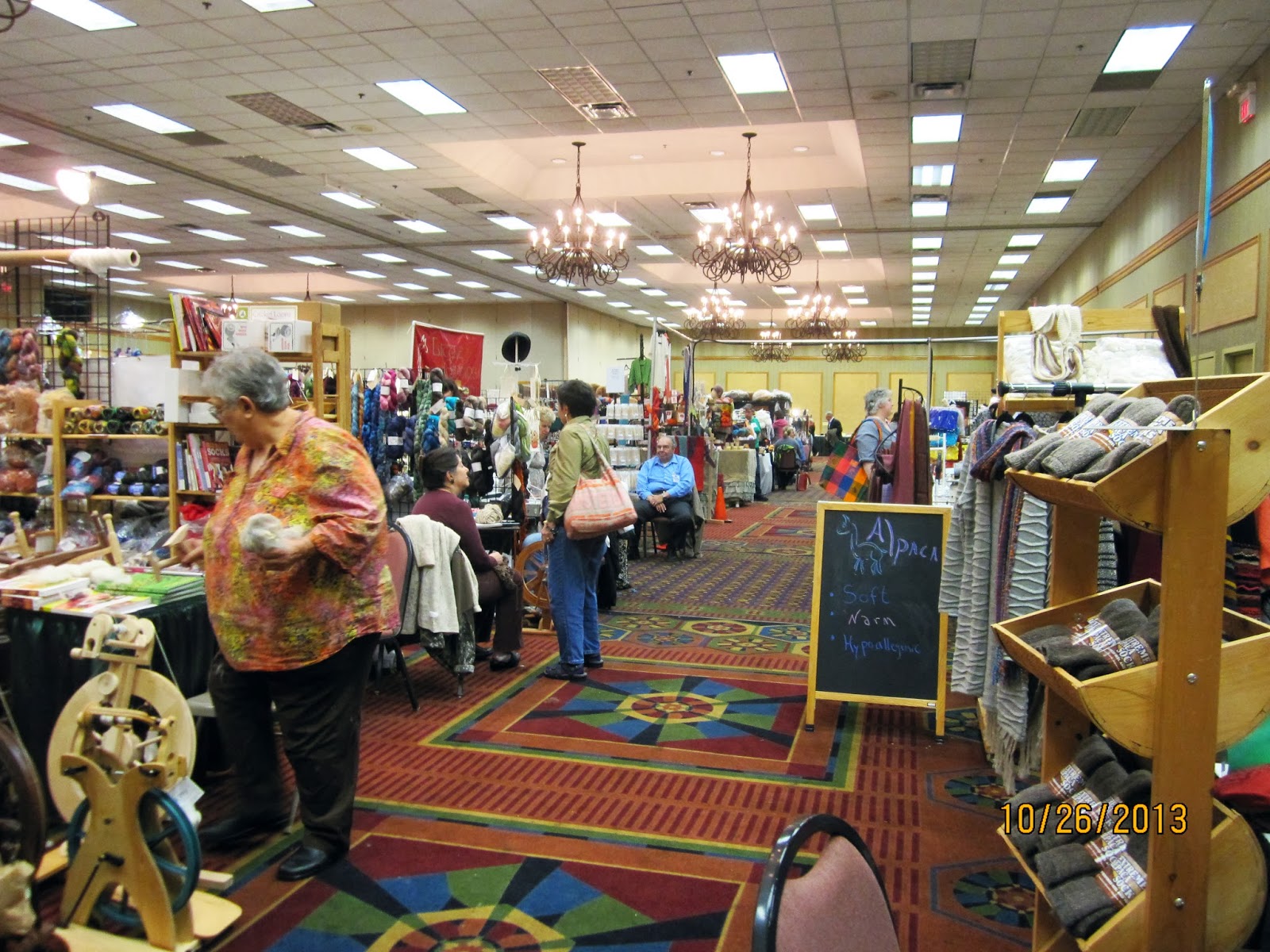 |
| The Marketplace Floor |
 |
| Sara Natani spinning with a Navajo spindle |
I chatted with some truly interesting people and learned a lot - for instance, Lauren and I spent a lot of time in the Jefferson Farms Natural Fibers booth; they specialize in Paco-Vicunas, and the owner Jane was incredibly friendly. She told us all about the fiber, and I am hoping to visit the farm in Colorado some day soon because it sounds amazing. I only wish I'd had an endless budget to bring home more of the fibery goodness that caught my eye. Instead, I practiced restraint and only purchased 3 items:

Another booth I spent a lot of time in was Fiber Curio and Sundries; Ellen explained that they source and process everything in the USA without the use of harsh chemicals, which is totally awesome. They had a lot of really unique fibers, and they could even tell me the name of the CVM sheep, Ella, whose fleece was used to make the top I purchased! How cool is that?!
Lauren purchased some really fun Polwarth-blend top from Lucky Cat Craft; they were another booth with a lot of unique fiber options, and though I didn't purchase anything at the show, I made a point to grab their card so I can check out their Etsy shop in the future!
I was so excited about my fiber purchases that I ended up spinning up a single of the black alpaca on Saturday night and Navajo plying it on Sunday:

Comments
Post a Comment