
FO Friday: A Multi-Craftual Creation

Weaving with worsted weight yarn is a little tough,
but it's worth the effort!
I'm excited to finally post about a project I've been working on for a VERY long time! I originally began it last summer, when I thought I would be making it to give as a holiday gift. However, I decided to put it on the backburner til 2014. Earlier this year, I pulled it out of hibernation to finish it in time for my grandmother's 90th birthday (which was this past Wednesday).

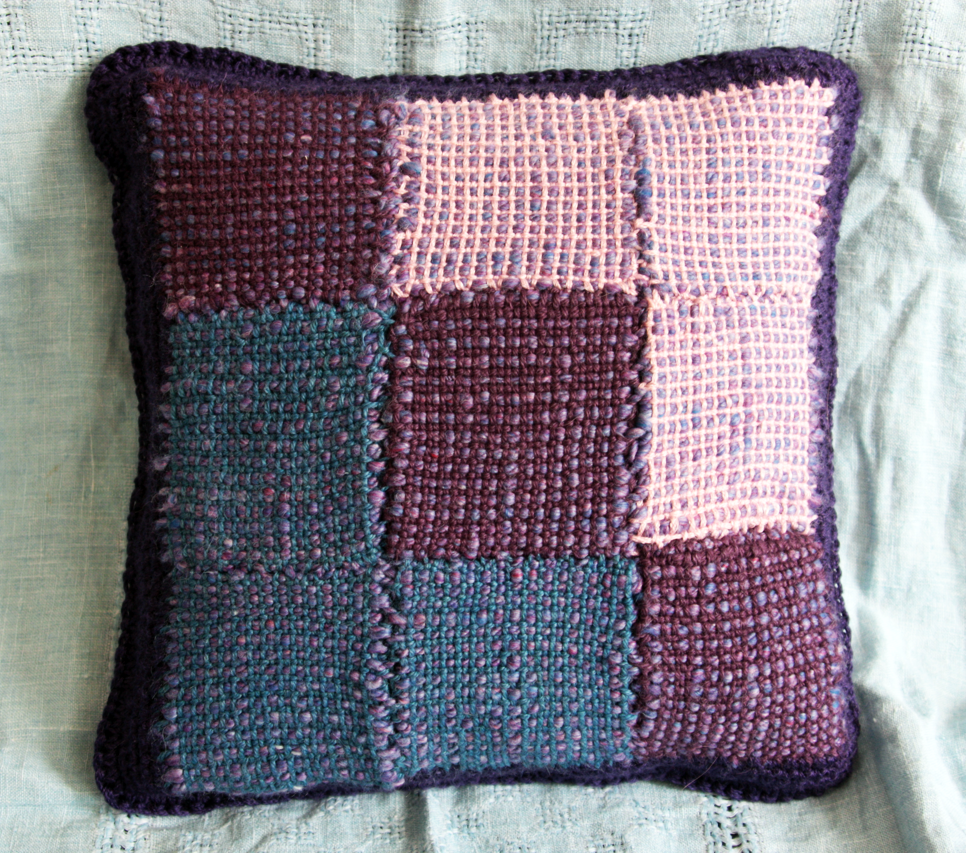
There is no pattern for this pillow, as I made it up as I went along. It began with the Schacht Zoom Loom I got at the TNNA Trade Show last summer, which I thought would be a fun way to use up leftover bits of yarn. My first squares were made with sock yarn, since that is what I have the most of in my stash, but I decided that using a thicker yarn would make a pretty great pillow fabric. I used leftover worsted yarns to warp the Zoom Loom, then created the weft (woven part) with my own handspun yarn. It was a little difficult to weave with such thick yarn, but the fabric it created was absolutely lovely!
One of the many configurations I experimented with
prior to seaming!
I made 9 squares which I seamed together; then, using a contrasting yarn color, I began crocheting a border in single crochet, increasing two stitches at each corner on every round.
Once I had a piece that was big enough to cover the front of a 12" square pillow, I grabbed some yarn which had been in my stash for quite some time (more on that in a second) and began crocheting a square, also in single crochet. I guesstimated how many stitches to make a square similar in size to the woven squares when seamed together; once the piece was finished, I worked a border in a similar fashion to the front piece, except I used two different colors.
When the front and back were basically the same size, I used the working yarn to crochet them together, saving myself a little seaming. It was a little awkward to do this with a pillow form sandwiched between them, but it was totally worth it to spare myself the odious task of seaming.

I'm pretty thrilled with how it turned out! What's even more exciting is the story behind the light pink, magenta and deep purple yarns used in this project: they were all purchased back when I lived in Portland, OR at a little yarn store in the NW called Lint (which isn't there anymore). I'd originally bought this yarn, Berroco Softwist, to make a project for my grandmother! Obviously, it didn't happen, and it languished in my stash for nearly 10 years...only to be used in a project for the very same grandmother!
These 3 colors of Softwist were originally purchased almost
10 years ago in Portland, OR!

Thanks for stopping by this week - for FO Friday inspiration, visit the Tami's Amis blog.


Have a crafty weekend! 


Comments

Popular posts from this blog

Australian Superfine Merino Yarn Review & Giveaway

After more than ten years of knitting, I can still have new experiences - even with well-covered territory such as merino yarn! This recent merino experience actually took me by surprise: I've spun with it, I've dyed it, I've knit with it, and I've even crocheted with it...I was pretty sure I knew all there was to know about merino! Turns out, there are four different classifications of merino fiber, sorted by micron count range . At the bottom of the spectrum is Strong Merino , which ranges from 26-22.9 microns; above that is Fine Merino , which ranges from 20.1-23 microns; next up is Extra Fine Merino, which ranges from 20-15.6 microns; and at the very top of the heap is Superfine Merino Wool , with a micron range of 18.5-15.6. If you're into numbers and wondering how these four classes stack up against other fibers you may be familiar with, here are a few for comparison's sake: BFL (Blue-Faced Leicester) has a micron range of 24-28, Cashmere goat down ...

App Review & Giveaway: Stash 2 Go

The developers for a paid Ravelry app for iPad and iPhone called Stash 2 Go contacted me earlier this year to see if I was interested in writing a review or their app on their blog. While I don't own an iPad or iPhone, I was able to gift a download to a knitting friend who had an iPad and was willing to let me play around with it for the purposes of this review! This is the first time I've ever accessed Ravelry via an app (on my Android phone, I typically use the m.ravelry.com site), and I found most of it to be easy to use. Some of the features weren’t intuitive to me at first, but once I got the hang of the idiosyncracies, it was smooth sailing. Stash 2 Go makes the most of API functions Ravelry has opened up to developers (there are still several areas which have yet to be completed in the Ravelry programming interface, so developers can only implement what is available through www.ravelry.com/api ). Most of the app's functionality allows the user to view the ...

A Finished Sweater, With Cat Hair

After losing Tilly and Robin within a year of each other, I sure didn't think I'd be finding cat hair in my knitting any time soon. But the universe had other ideas. Over the winter, a white feral cat adopted us. I'd noticed her when we moved into our apartment last summer - I would see her hiding in the bushes or sunning herself in the grass when she thought no one was looking. I assumed she was someone's cat until I realized how skittish she was around humans, plus she had a tipped ear, which is a universal sign that a feral/stray cat has been spayed. Neighbors confirmed that she was a feral kitty (descended from several generations of feral cats, in fact), and that she has survived on her wits and whatever food various residents put out for her.  We had some bitterly cold days over the winter, and I just felt so sorry for this poor kitty! I started offering her treats and slowly gained her trust. She didn't even want to come inside our apartment at first, much le...